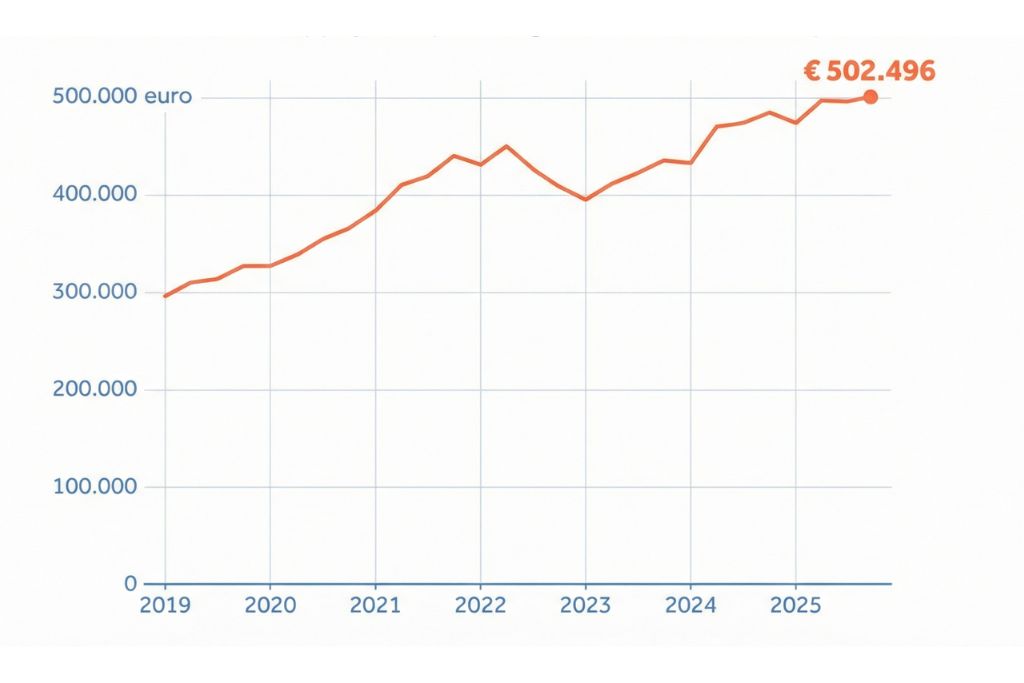
Average house prices graph Netherlands 2026
The average house price in the Netherlands exceeded €500,000 in 2026. That level is significantly higher than in previous years and shows how fast house prices have risen, despite small quarterly fluctuations.
Average house prices in the Netherlands per year:
- 2015: €235,000
- 2020: €335,000
- 2023: €410,000
- 2026: €502,000
Average home prices chart
{{cta}}
What does the increase in the average sales price for starters mean?
The rise in house prices affects first-time buyers directly. The average retail price is higher than last year, while your mortgage is growing less rapidly. This puts pressure on affordability. According to NVM figures, the housing market remains tense, despite a slight decline in some regions.
What you notice now as a starter:
- Existing homes for sale are becoming more expensive than you expect.
- The asking price is often higher than what starters can borrow.
- You need a higher salary to be able to get sufficient mortgage for the purchase.
- Brokers require quick decisions.
- Competition among home buyers is increasing.
The price development varies greatly by municipality and province. In municipalities such as Bloemendaal, Wassenaar and Laren, the level is structurally high. In Stede Broec, Enkhuizen, Uitgeest, Wageningen, Barendrecht and Veldhoven, homes for sale are relatively more affordable. This shows that there are major differences, even within the Randstad and beyond.
Analyses by the NVM show that the number of housing transactions increased in the past quarter. This is partly because landlords are selling their existing homes. As a result, the number of sales and the number of homes sold are increasing, but that does not automatically mean lower house prices. Many of these home sales are still outbid.

How can you still buy a house as a starter in 2026?
House prices are high, but starters also have advantages. You only see them when you know where to look and when you have someone next to you who knows the market. That's where homeup as a buying agent for starters makes the difference.
Starters have more chances than you think
Historic home prices show that getting in feels exciting at every peak. This was the case before the financial crisis and it is no different now. Yet time and again, it appears: start-ups who buy well prepared build up wealth in the longer term. Not by gambling, but by choosing wisely.
What works in your favor now:
- Transfer tax exemption up to €555,000 for starters.
- More supply through new-build homes and expansion.
- Relatively many transactions in the starter segment.
- More focus on smaller housing types, such as apartments.
Less competition with the right type of home
Starters are increasingly focusing on apartments and compact homes. This provides more overview and fewer extreme bids compared to large family homes. For new-build homes, the price is often calculated in advance, so you don't have to outbid. That provides peace and security. On average, you pay €494,000 for new-build homes.
Starters buy more rationally than people who move on
Where people who move on often rely on emotion and excess value, starters look more closely at monthly costs and risks, which works to your advantage. Especially in an uncertain economy. By making realistic calculations, you avoid paying too much and build trust in your choice as a consumer.
Why a buying agent pays off for starters
As a starter, you have one big advantage: you can do it differently than the rest. Provided you choose the right guidance. homeup is not a standard buying agent, but is specially set up for starters who want to keep a grip on their purchase.
Here's what homeup does specifically for you as a buying agent:
- Hassle-free legal and administrative help. Buying a home means stacks of documents. Think of the purchase contract, resolutive terms and fine print. Homeup guides you through the legal maze and explains everything clearly. This way, you can sign with confidence and without surprises afterwards.
- Priority over exclusive fixed price offers. If you use homeup as a buying agent, you will get priority over an exclusive property offer. These homes have a fixed price, so you don't suffer from overbidding, stress and you get a fair shot at a home.
- Objective and honest advice every step of the way. homeup is watching critically. What are the advantages? Where are the risks? You will receive honest advice about the home, possible sustainability and what a strong offer is.
- Bidding without reservation of funding. Through an experienced mortgage advisor, you get free insight into what you can borrow and what monthly costs are associated with it. This way, you can make an offer without reservation of funding. That makes you a stronger buyer without taking irresponsible risks.
{{cta}}